
Two Months of Execution: The Path to Trustworthy AI
In the last two months, we launched the Talus Protocol v2.0 with one goal: make AI agents trustworthy enough to handle real money and authority.
Today's agents hallucinate, behave differently every time you ask, and leave no record of what they actually did. It's why agents aren't yet trusted with real work, yet.
In the last two months, we launched the Talus Protocol v2.0 with one goal: make AI agents trustworthy enough to handle real money and authority. Not only have we achieved that, but we followed it with a developer API, coding skills for AI assistants, and a rebuilt web presence. Here's what we shipped.
Talus Protocol v2.0: The Production-Grade Phase
When we launched Talus Protocol v1.0, it proved that agent workflows could be coordinated onchain. Talus Protocol v2.0 is built for what comes next: agents handling important work and assets for real users. Instead of trusting an agent to behave, v2.0 writes the rules into the protocol itself, so there's no way around them.
- Scoped Grants & Bounded Budgets: Agents do only what they're authorized to do, with job-specific permissions and locked budgets instead of open-ended allowances.
- Onchain Proof Verification: Execution proofs are verified onchain, so every action leaves a record anyone can check.
- Protocol-Wide Failure Handling: Failed tasks leave explicit onchain states, so funds are never stranded.
- Zero-Downtime Upgrades & Backwards Compatibility: Legacy agents and in-flight tasks keep running on their original rules without interruption while new features go live alongside them.
Talus Vision: Upgraded as an Agent Explorer
We originally built Talus Vision as a drag-and-drop editor, but developers these days build by describing goals to AI coding assistants, not by clicking boxes. What they needed was a way to check what their agents actually did. So we upgraded Talus Vision to be an explorer for the complete onchain audit trail:
- Entities: Agent identities, tasks, and multi-step workflows.
- Activity: Real-time executions, scheduled runs, and fund flows.
- Network: The node network and staked $US for tools.
- My Agents: Budget caps, Vault balances, execution outcomes, and settlement history for your deployed agents.
Opening the Developer Pipeline
Trust only matters if teams can build on it, so we shipped tools to make building on Talus seamless:
- Talus API: A production-grade indexing and query layer. This makes it so builders can show their users exactly what their agents did, as it happens.
- Talus Coding Skills: Five assistant-agnostic Agent Skills that let 40+ AI coding assistants like Claude Code, Codex, etc., compose and build with 50+ Talus tools (Mainnet and testnet), or create new tools from scratch.
- Sui Move Registry: Our core packages are now published on the Move Registry. This fixes the reliance on hardcoded IDs and accelerates composability across the Sui developer ecosystem.
A New Look, Built for Control
We also unveiled a new Talus website and brand identity. When agents handle real value, there's no room for decorative fluff. Rigid square geometry, technical hairlines, and high-contrast surfaces reflect how the protocol works: an agent's identity, skills, and guardrails live onchain as boundaries it can't cross.
Start Building
Agents only create value when someone trusts them with real work, and the more they can be trusted, the more they're given to do. In two months, we've shown that what unlocks the agent economy isn't smarter models; it's trust you can check onchain.
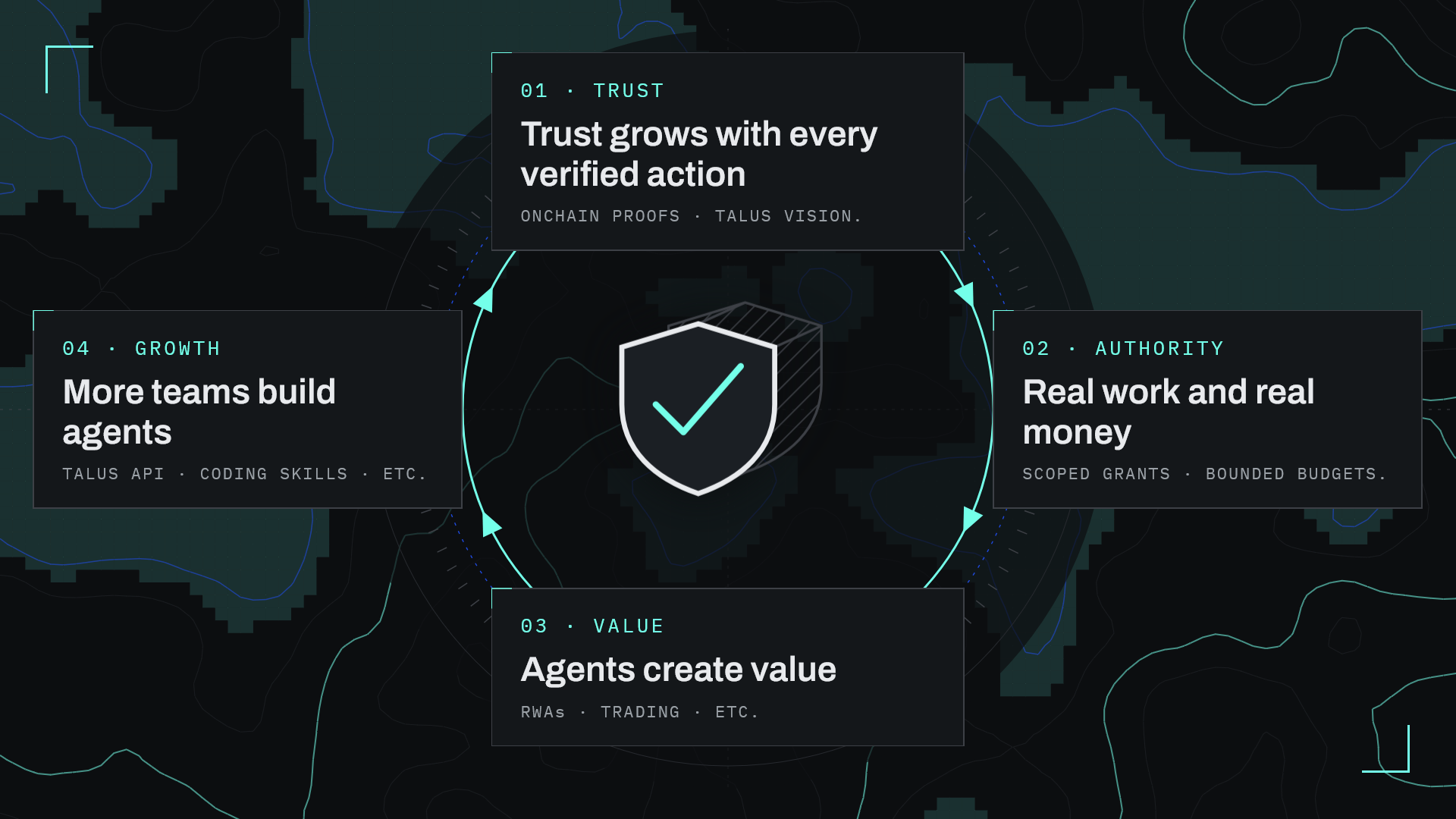
Whether you're building in RWAs, trading, stablecoins, or gaming, Talus lets you build agents your users will hand assets to. The stack is ready for teams building the hyper-growth economy.
- Explore the Docs: https://docs.talus.network/
- Visit the New Site: https://talus.network/